

Proof of shifts between extreme drought and heavy rainfall before a major climate tipping point has been found for the first time in ancient lake sediments.
The new study by a team including Professor Henry Lamb, from Aberystwyth University’s Department of Geography and Earth Sciences reveals for the first time that the sudden tipping point from humid to arid conditions in northern Africa 6,000 years ago was preceded by climatic ‘flickers’.
These flickers are a series of alternations between extremely wet periods and droughts, each lasting between 20 and 80 years, over a thousand-year period.
Published in the journal ‘Nature Communications’, the researchanalyses several wet–dry transitions in the 620,000-year environmental record from the Chew Bahir basin in the southern Ethiopian Rift.
Before now the flickering between wet and dry periods ahead of major climate transitions had previously only been predicted in theory.
The new findings point to the possibility of a future climatic tipping point, where the climate shifts suddenly and drastically to a new state.
These rapid environmental changes had a major impact on humans in northern Africa, as grasslands, open forests, and lakes disappeared.
That climate shift, known as the end of African Humid Period, resulted in human populations becoming largely restricted to favourable habitats in mountains, oases and in the Nile Valley.
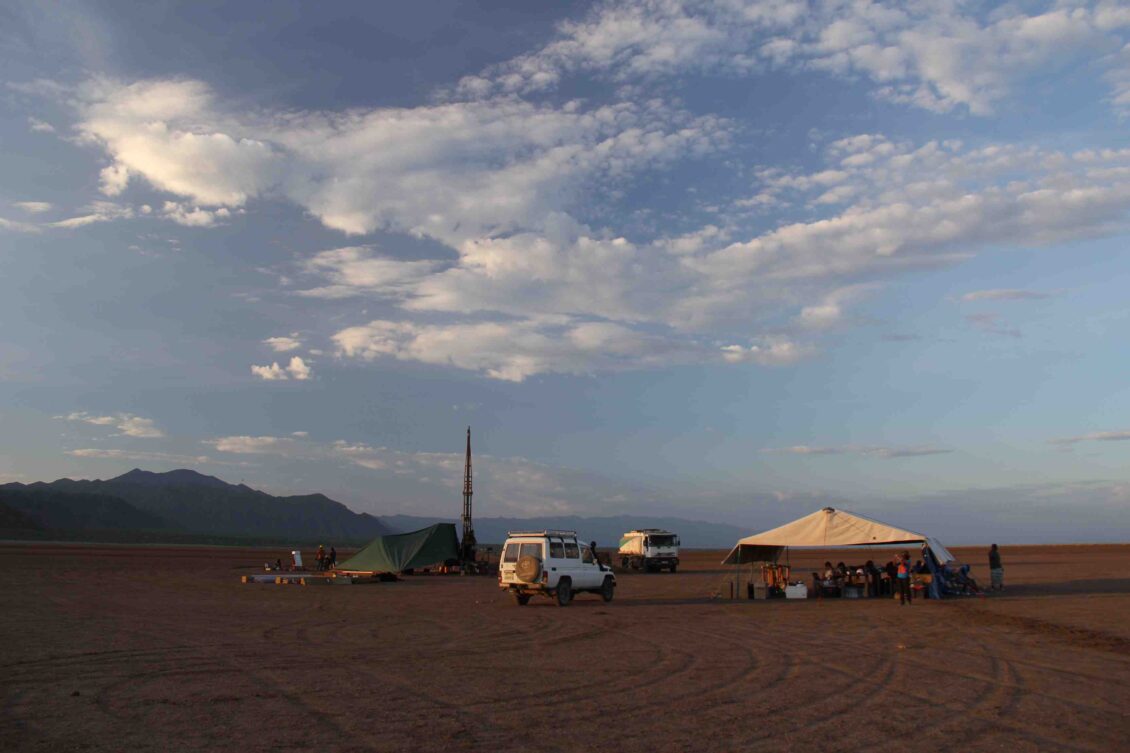
The international team, including Professor Lamb, collected 600,000-year-old samples from the sediments of Chew Bahir, a dry lake in south Ethiopia. He said:
“The confirmation of the existence of this extreme ‘flickering’ between wetness and drought several times in the past may provide insights into possible early warning signals for future large-scale climate tipping points.
This is a real and dangerous possibility as human activity forces change in the climate system.
“This has happened in the past, with dramatic consequences for human populations, as our new data from south Ethiopia shows. The long core record we obtained shows that similar flickering climate also occurred in advance of much earlier transitions in the climate, implying that such tipping points can occur naturally, long before human impact on the climate.
“We see climate flickers as warning signals of the potentially catastrophic effects that future tipping points would have on the biosphere, including human populations. Clearly, it is important to consider current climate fluctuations as possible warning signs of climate breakdown, not just in Africa, but also in other sensitive climate systems such as the North Atlantic.”
Climate modellers have identified two main types of tipping points. In one type, processes change at an increasing rate and the climate has a hard time recovering from disturbances until a transition occurs. The second type is characterised by a flickering between stable humid and dry climates that occurs shortly before the transition.
Potsdam University geoscientist Prof. Dr. Martin H. Trauth added:
“The two types of tipping points differ with regard to the early warning signals that can be used to recognise them. Researching and better understanding them is important if we want to be able to predict possible future climate tipping points caused by humans. While the slowdown seen in the first type of tipping point leads to a decrease in variability, autocorrelation, and skewness, the flickering in the second type leads to the exact opposite – and, in some cases, to the impending tipping point not being recognised.”
The project was funded, among others, by the German Research Foundation (DFG), the U.S. National Science Foundation and the UK Natural Environment Research Council.
